● Time tracking
Is clocking in by phone allowed? What Brazil's Portaria 671 says
Yes, clocking in by phone is allowed in Brazil, as long as the system follows Portaria 671. See the REP-P requirements, personal phone use and LGPD care.
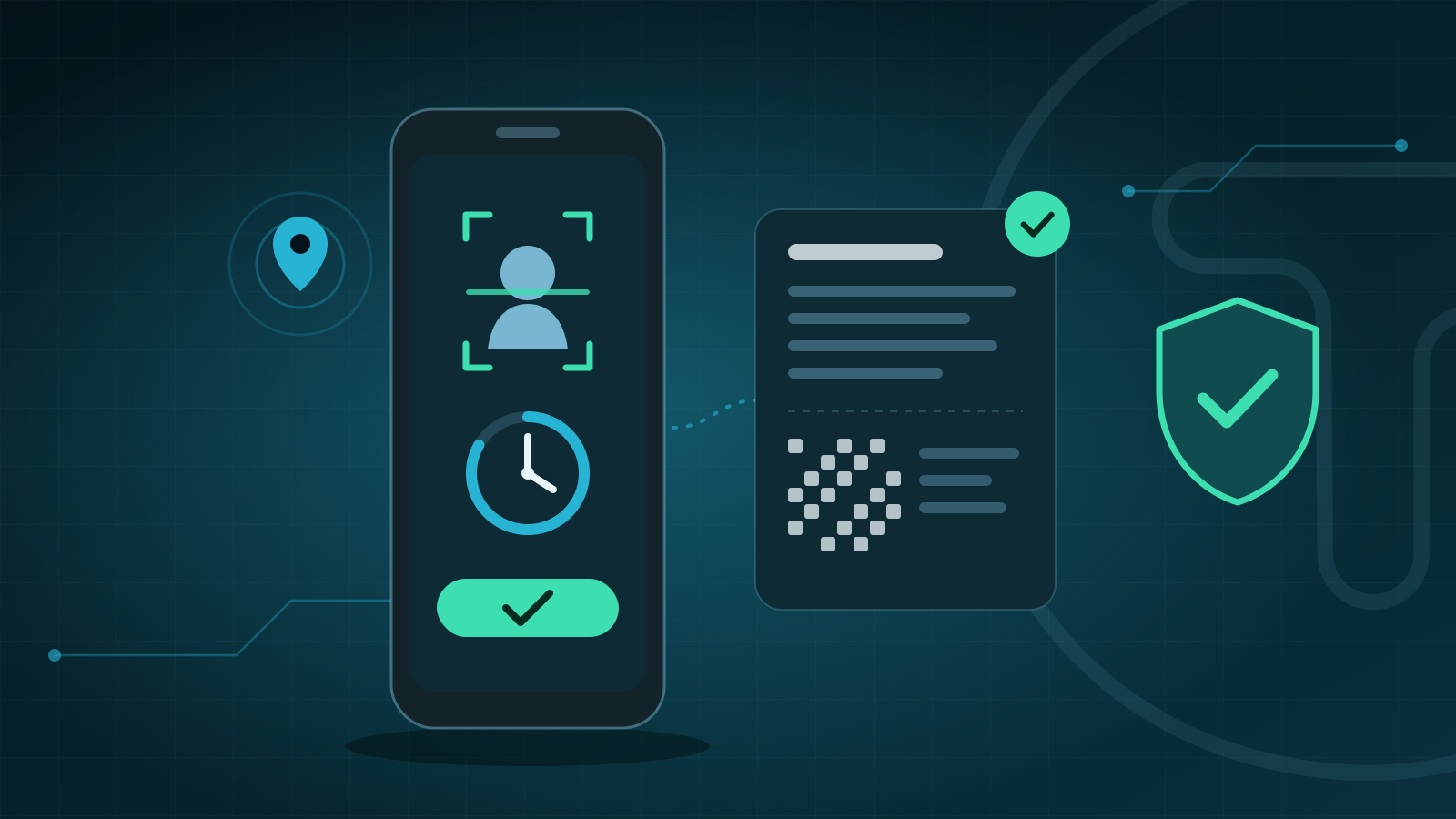
Yes. Clocking in by phone is allowed in Brazil, as long as the system follows Portaria MTP nº 671/2021, the rule from Brazil's Ministry of Labor and Employment (MTE) that regulates electronic time tracking. In the ordinance's language, the phone app is a clock-in collector (coletor de marcações) for a REP-P (registrador eletrônico de ponto via programa, the software-based time recorder). What the rule does not accept is just any app: one with no registration, no receipt for the worker or a loophole for changing the times.
For companies with teams spread across sites, such as security, cleaning, front desk and facilities, the phone is often the most practical way to track working hours. Here is what the system needs to have, what changes when employees use their own device and what care the LGPD (Lei Geral de Proteção de Dados, Brazil's data protection law) calls for.
What the law says
The CLT (Consolidação das Leis do Trabalho, Brazil's labor code) requires establishments with more than 20 workers to record start and end times, in a manual, mechanical or electronic record (art. 74, § 2º). When the work is done outside the establishment, the record is held by the employee (§ 3º). And exception-based recording (ponto por exceção), in which only hours outside the regular schedule are recorded, is allowed through a written individual agreement or a collective agreement, known as convenção or acordo coletivo (§ 4º).
Portaria 671 defines the three accepted types of electronic time-recording system (art. 75):
- REP-C: the conventional time clock, a certified device that stays at the workplace;
- REP-A: the alternative system, valid only while it is authorized by a collective agreement (art. 77);
- REP-P: the software-based system, made up of the REP-P itself, the clock-in collectors, the storage of records and the processing software (programa de tratamento de registro de ponto).
REP-P is where the phone comes in. The ordinance defines clock-in collectors as "equipment, physical devices or programs (software) capable of receiving and transmitting to the REP-P the information on clock-ins" (art. 75, sole paragraph). The rule does not mention phones or smartphones: any device will do, as long as the system meets the requirements.
REP-P requirements
| What the system needs to have | Where it is in Portaria 671 |
|---|---|
| Software with a registration certificate from INPI (Brazil's industrial property office), running on a dedicated server or in the cloud | Arts. 78 and 91 |
| Identification of the company and the worker, and unequivocal identification at each clock-in | Annex IX, items 1 and 8.1 |
| Clock synchronized with Hora Legal Brasileira (official Brazilian time), with a maximum deviation of 30 seconds | Annex IX, item 2 |
| Clock showing hours, minutes and seconds at the moment of clock-in | Annex IX, item 3 |
| Online clock-ins; offline only as an exception, sent as soon as the device reconnects | Annex IX, items 4 and 5 |
| Records that cannot be deleted or altered, with a hash code (SHA-256) for each clock-in | Annex IX, items 6.5 and 7 |
| A receipt after each clock-in, as a signed PDF, with access to the clock-ins from the last 48 hours | Arts. 79 and 80 |
| AFD and AEJ files and the timesheet (espelho de ponto) available to labor inspectors | Arts. 81, 83, 84 and 85 |
| Signatures with an ICP-Brasil digital certificate (Brazil's public key infrastructure) | Art. 88 |
| Atestado Técnico e Termo de Responsabilidade (technical certificate and statement of responsibility) provided by the vendor | Art. 89 |
The AFD (Arquivo Fonte de Dados, source data file) holds the original clock-ins; the AEJ (Arquivo Eletrônico de Jornada, electronic working-hours file) holds the processed working hours. With a REP-P, the AFD must be promptly generated and delivered when the labor inspector requests it (art. 81, § 2º), and the files and reports from the processing software must be provided within a minimum of two days, at the inspector's discretion (art. 85).
What the app must not do
The ordinance requires the system to faithfully record clock-ins and prohibits (art. 74):
- restricting the times when workers can clock in;
- automatic clock-ins using predetermined times or contractual hours (which is not the same as the CLT's exception-based recording);
- requiring prior authorization to record overtime;
- any feature that allows changing the data recorded by the employee.
In practice, an app that blocks clock-ins outside the schedule or lets a manager edit the recorded time does not comply with the rule. Working-hour corrections do exist, but they happen in the processing software, which shows both the original and the processed clock-ins on the timesheet (art. 84, V).
What if employees use their own phone?
Portaria 671 does not require a company device and does not prohibit personal phones. The question comes up elsewhere: who pays the bill. Under the CLT, the employer bears the risks of the economic activity (art. 2º), and labor courts have already applied this logic to phones:
- Sete Lagoas (Minas Gerais): the 3rd Labor Court (3ª Vara do Trabalho) ordered a company to pay R$30 a month to a test driver who used his personal phone to clock in and send photos. The judge limited the amount because the phone was also used for personal purposes. There was no appeal (news report of March 14, 2024 from TRT-MG, the Regional Labor Court of Minas Gerais).
- Belo Horizonte: the 43rd Labor Court set R$60 a month for a field sales representative who used his personal phone for work, including as a way for the company to monitor his working hours. The amount is due until the company provides a corporate device. The ruling cited the alteridade principle (the employer bears the risks of the business) and art. 2º of the CLT, and the parties appealed (TRT-MG news report of April 1, 2024).
These are first-instance decisions, and each case depends on the evidence. The message is that requiring a personal phone has a potential cost. That is why a written policy is worth having: who may use their own device, whether there is an allowance for mobile data and what the alternative is for people who do not have a phone or do not want to use their own, such as a shared device at the site, a computer or a time clock.
LGPD: location and biometrics
Portaria 671 requires compliance with the LGPD when processing time-tracking data (art. 101), but it says nothing about geolocation or facial recognition. Both features are the company's choice and need a justification:
- Biometrics: the image of the face used to identify the worker is sensitive personal data (LGPD, art. 5º, II), which calls for extra care with the legal basis, security and access.
- Location: under the principles of purpose and necessity (art. 6º, I and III), the data must serve a purpose the worker has been told about and be limited to the minimum necessary, such as the position at the moment of clock-in, not tracking all day long.
We cover both topics in detail in Geofencing for time tracking: a practical guide for field teams and in Facial recognition and liveness detection: how to stop buddy punching.
Field teams and sites with no signal
- No internet: offline clock-ins are allowed as an exception and must be sent as soon as the device reconnects (Annex IX, items 4 and 5). The MTE clarifies that offline mode is not mandatory for a REP-P, because some architectures do not allow this type of clock-in. If your sites have a weak signal, ask the vendor before signing.
- Receipt: workers must have access to the receipt after each clock-in, without having to ask for it (art. 80, II). On a phone, it usually appears in the app itself.
- Exception-based recording: according to the MTE, it is not a type of recorder but a way of recording working hours, and it can work with a REP-P when authorized by an individual agreement or a collective agreement.
What to do now
- Ask the vendor for the REP-P's INPI registration certificate and the Atestado Técnico e Termo de Responsabilidade
- Check that the app shows the clock with seconds and issues a receipt after each clock-in
- Test that the system prevents editing clock-ins, does not restrict times and does not require authorization for overtime
- Set in writing who uses a personal phone, who pays for the data and what the alternative is for people without a device
- Review the use of geolocation and facial recognition with your legal team in light of the LGPD
- Make sure the AFD, the AEJ and the timesheet can be generated for labor inspectors
- Brief teams on how to clock in and where to find the receipt
Frequently asked questions
Can a company require employees to use their own phone to clock in?
Portaria 671 does not address the device. In labor courts, there are decisions ordering companies to reimburse workers when the use of a personal phone is required, such as the Minas Gerais cases that set R$30 and R$60 a month. The safest approach is to offer an alternative and set the rule in writing, with support from your legal team.
Does clocking in by phone work without internet?
It can, but only as an exception: the ordinance allows offline clock-ins, which must be sent as soon as the device reconnects. The MTE clarifies that this mode is not mandatory for a REP-P, so it depends on the system you choose.
Does a screenshot count as a receipt?
It does not replace the official receipt. With a REP-P, the receipt is an electronically signed PDF, available after each clock-in, with data such as the Número Sequencial de Registro (NSR, a sequential record number), the program's INPI registration number and the hash code of the clock-in (arts. 79 and 80).
Conclusion
Clocking in by phone is allowed and, for teams spread across sites, it is often the most practical format. What separates valid time records from a labor liability is the system (a registered REP-P that issues receipts and does not allow clock-ins to be changed), the device use policy and care with the data. For the full details of the rule, see Portaria 671 and electronic time tracking in Brazil: a complete guide.
Want to see how this works in your operation? Talk to the Tirvu team and see TIRVU+ time tracking, compliant with Portaria 671, with facial recognition, liveness detection, geolocation and offline mode: in the employee app, on a TIRVU Tab shared at the site, on a computer with a webcam, on T-Client or on Evo Facial and Control iD time clocks.
Sources
- MTE, Brazil's Ministry of Labor and Employment: Portaria MTP nº 671/2021, consolidated text as of Jul 21, 2026 (PDF)
- MTE, Brazil's Ministry of Labor and Employment: questions and answers on Portaria 671/2021 (electronic time recording)
- Planalto, Brazil's Presidency: Consolidated Labor Laws (CLT), arts. 2º and 74
- Planalto, Brazil's Presidency: Lei 13.709/2018, Brazil's data protection law (LGPD), arts. 5º and 6º
- TRT-MG, the Regional Labor Court of Minas Gerais: test driver to be compensated for using a personal phone at work (Mar 14, 2024)
- TRT-MG, the Regional Labor Court of Minas Gerais: company must compensate field sales representative for using a personal phone on the job (Apr 1, 2024)
This content is for informational purposes only and does not replace specialized legal advice.
- #time tracking
- #mobile time tracking
- #Portaria 671
- #REP-P
- #LGPD
- #outsourcing
Want to see this in action in your operation?
Talk to a specialist and get a demo built around your company's scenario.